Protein After 50: Research Summary and Data for Journalists and Clinicians
This data page compiles the key research findings on protein needs after 50 — sarcopenia prevalence, anabolic resistance evidence, per-meal leucine thresholds, and the gap between the RDA and what research actually supports — for journalists, clinicians, and health writers.
01RDA of 0.8 g/kg was established to prevent deficiency in young adults — not to optimize muscle in aging
02PROT-AGE and ESPEN recommend 1.2 to 1.6 g/kg for adults over 65 — 50 to 100% above the RDA
03Anabolic resistance: older adults need 40% more leucine per meal for the same muscle protein synthesis response
04Leucine threshold shifts from 1.7 g per meal (young adults) to 2.5 to 3.0 g per meal (adults over 65)
05Sarcopenia affects 10 to 50% of adults over 60 depending on criteria — the most addressable risk factor is protein + resistance exercise
The RDA vs. Research-Based Recommendations: A Critical Gap
The U.S. Recommended Dietary Allowance (RDA) for protein is 0.8 g/kg per day for all adults over 18. This value has not been revised since 1989 and was established based on nitrogen balance studies primarily conducted in young adults. It represents the amount needed to prevent deficiency in 97.5 percent of the healthy adult population — not the amount needed to optimize muscle health with aging.
Protein recommendations by organization — comparison to U.S. RDA
Organization / Study Group
Recommendation for adults 65+
Notes
U.S. RDA (DRI 2005)
0.8 g/kg/day
Prevents deficiency in healthy adults; not age-specific
PROT-AGE Study Group (2013)
1.0 to 1.2 g/kg/day (minimum); 1.2 to 1.6 g/kg active
International expert consensus on protein and aging
ESPEN Expert Group (2014)
1.0 to 1.5 g/kg/day
European nutrition society; based on aging-specific evidence
ESPEN Clinical Guidelines (2022)
1.2 g/kg/day minimum; up to 2.0 g/kg for ill or injured
Updated clinical guidelines for hospitalized older adults
Paddon-Jones et al. (2015)
1.0 to 1.3 g/kg/day
Key researchers in protein and muscle aging
Phillips et al. (2016)
1.0 to 1.6 g/kg/day depending on activity
McMaster University muscle metabolism research group
Bauer et al. (2013) — PROT-AGE consensus
25 to 30 g high-quality protein per meal (minimum 3 meals)
Per-meal target rather than daily total; more practically applicable
Sarcopenia: Prevalence Statistics and Impact Data
Sarcopenia prevalence by age group and diagnostic criteria
Population group
Prevalence range
Criteria used
Functional consequences
Adults 60 to 69 years
5 to 13%
EWGSOP2 criteria (2018)
Increased fall risk, early disability
Adults 70 to 79 years
11 to 20%
EWGSOP2 criteria (2018)
Significant fall, fracture, and mortality risk
Adults 80+ years
20 to 50%
Variable criteria; higher with low thresholds
Major driver of nursing home admission
Community-dwelling adults 60+
~10% (severe criteria)
EWGSOP2 (grip + mass/performance)
Conservative estimate; functional loss much broader
Obese older adults (sarcopenic obesity)
4 to 12% of adults 60+
Combined BMI + sarcopenia criteria
Higher metabolic and cardiovascular risk than either alone
Adults with type 2 diabetes, 65+
Up to 45% prevalence
Diabetes compounds sarcopenia mechanisms
Accelerated muscle loss with insulin resistance
Sarcopenia economic and health impact data
Impact metric
Data
Source
Fall risk increase with sarcopenia
2.3x higher odds of falling
Meta-analysis, Landi et al.
Fracture risk with sarcopenia
2.7x higher odds of fracture
Meta-analysis review
Mortality increase with severe sarcopenia
1.7x higher all-cause mortality
Longitudinal cohort studies
Estimated U.S. healthcare cost of sarcopenia
$18.5 billion annually (2000 estimate)
Janssen et al. (2004); likely higher currently
Rate of muscle loss per decade without intervention
3 to 8% of muscle mass
Cross-sectional and longitudinal studies
Rate of muscle strength loss per decade
10 to 15%
Greater than mass loss — reflects neuromuscular changes
Anabolic Resistance: The Key Mechanism Behind Higher Protein Needs
Anabolic resistance — the reduced responsiveness of muscle protein synthesis to protein intake with age — is the biological justification for higher protein recommendations in older adults. Multiple controlled studies have demonstrated this phenomenon.
Key research findings on anabolic resistance with aging
Study finding
Young adults
Older adults (65+)
Implication
Minimum leucine per meal to trigger MPS
1.7 to 2.0 g
2.5 to 3.0 g
Older adults need higher leucine per meal — favors animal proteins and whey
Protein dose needed for peak MPS
20 to 25 g per meal
30 to 40 g per meal
Per-meal protein targets must increase with age
Anabolic response to 40 g vs 20 g protein (young)
Similar — 20 g near-maximizes MPS
Higher — 40 g produces significantly more MPS than 20 g
Older adults benefit from higher per-meal doses that young adults do not need
MPS rate postprandially (young vs old, equal protein)
1.8-fold increase over baseline (young)
1.3-fold increase (older, same dose)
Same protein produces lower MPS response in older adults
Effect of added leucine on MPS in older adults
Minimal additional effect when protein is adequate
Significant improvement — 2.5 g leucine supplement closes the gap
Leucine supplementation useful when plant proteins or lower-dose protein predominate
Protein Distribution Across Meals: What the Research Shows
Research on protein distribution patterns and muscle protein synthesis outcomes in older adults
Distribution pattern
Daily total
MPS outcome
Notes
3 even meals of 30 g protein each
90 g/day
Best MPS response in multiple studies
Gold standard protein distribution for older adults
1 large protein meal (70 g) + 2 small (10 g each)
90 g/day
Significantly worse MPS than even distribution
Skipping breakfast protein is a major miss
5 to 6 small meals of 15 to 18 g each
90 g/day
Good but below the 30 g threshold for peak MPS per meal
May be practical for small appetites; less ideal for MPS maximization
RDA pattern (0.8 g/kg for 70 kg = 56 g/day)
56 g/day (3 meals of ~19 g)
Below MPS threshold for older adults at each meal
Why the RDA is insufficient — not enough per meal OR per day
Leucine Content by Protein Source: Why Source Matters After 50
Leucine content per 25 g of protein from common food sources
Food source
Leucine per 25g protein
Meals needed to reach 2.5g leucine threshold
Notes
Whey protein concentrate
~2.7 g
1 meal (one serving ≥30g protein)
Highest leucine density of common protein sources
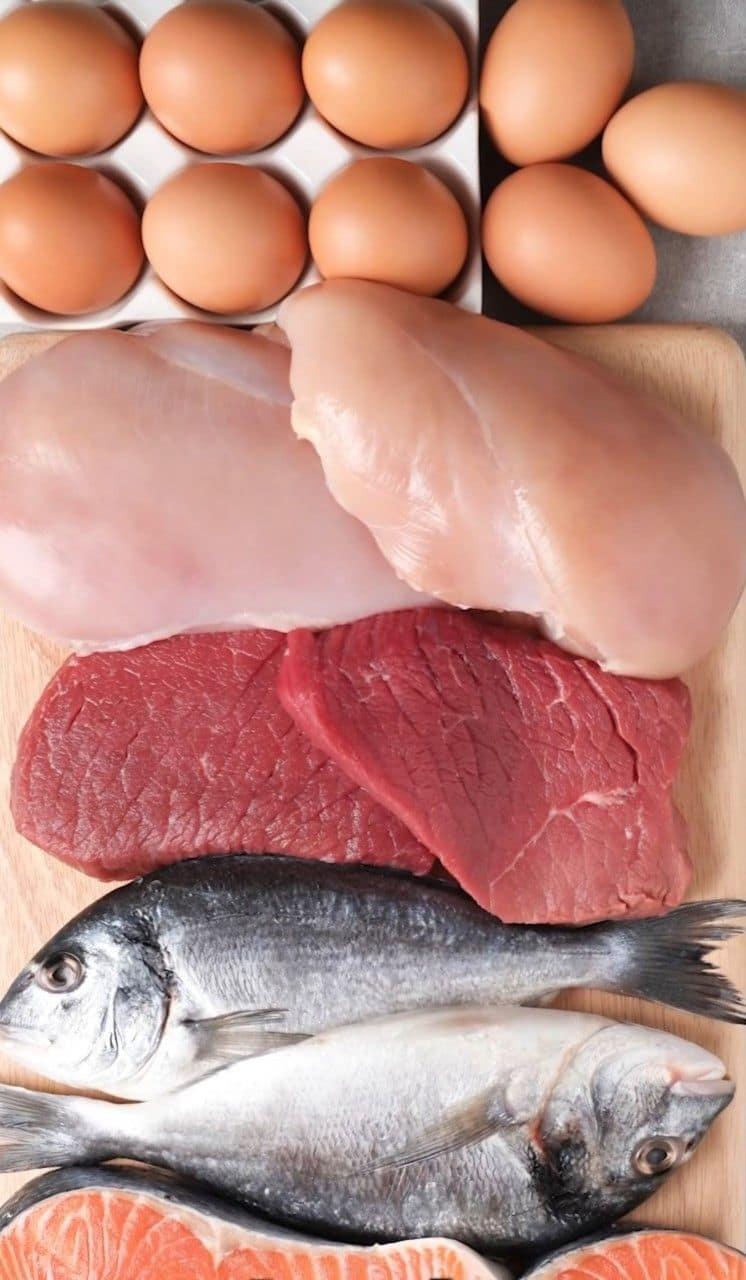
Chicken breast
~2.2 g
1 to 1.5 meals (need ~30g protein)
Good leucine density; practical everyday food
Eggs (whole)
~2.0 g
1.2 meals (need ~31g protein)
Excellent leucine density; complete amino acids
Salmon
~2.1 g
1.2 meals
Also omega-3; excellent for older adults
Cottage cheese
~2.0 g
1.2 meals
High casein (slow-release); good for overnight muscle maintenance
Greek yogurt
~1.6 g
1.6 meals
Lower leucine density than solid proteins
Lentils
~1.3 g
2 meals (need ~50g protein from lentils)
Requires higher total protein to meet leucine threshold
Black beans
~1.2 g
2+ meals
Combine with high-leucine source or leucine supplement
Tofu
~1.1 g
2+ meals
Lower leucine; soy protein isolate is better than tofu for this purpose
Real stories, coming soon
Real people, real results
We're putting together real stories from people who use ZavoFit's guidance in everyday life. Coming soon.
Questions, answered.
What does research say about protein needs after 50?
The research consistently shows that the standard RDA of 0.8 g/kg per day is insufficient for muscle maintenance in adults over 50. The PROT-AGE Study Group (2013) and ESPEN guidelines recommend 1.0 to 1.2 g/kg per day as the minimum, with 1.2 to 1.6 g/kg recommended for active older adults or those with acute illness. Some researchers advocate 2.0 g/kg for clinical settings.
What is anabolic resistance and how much does it affect protein needs?
Anabolic resistance is the reduced efficiency of muscle protein synthesis in response to protein intake that occurs with age. Research shows that older adults require 40 percent more leucine per meal compared to younger adults to achieve the same muscle protein synthesis response. This means a meal providing 20 g of protein that is sufficient for a 30-year-old may need to provide 30 to 35 g for a 60-year-old to produce the same anabolic response.
What is the leucine threshold for muscle protein synthesis?
The leucine threshold — the minimum amount of leucine needed per meal to trigger meaningful muscle protein synthesis — increases with age. In young adults, approximately 1.7 to 2.0 g of leucine per meal is sufficient. In adults over 65, research suggests 2.5 to 3.0 g of leucine per meal is needed. This is why high-leucine protein sources (whey, eggs, animal proteins) are disproportionately important for older adults.
How common is sarcopenia?
Sarcopenia prevalence varies by diagnostic criteria and population studied. Estimates range from 5 to 13 percent of adults aged 60 to 70, rising to 11 to 50 percent in adults over 80. Using the 2019 EWGSOP2 criteria (low muscle strength + low muscle mass or performance), approximately 10 percent of community-dwelling adults over 60 qualify. The functional consequence — increased falls, disability, and mortality — affects far more.
What does protein distribution across meals matter?
Research shows that distributing protein evenly across 3 to 4 meals (30 to 40 g per meal) produces significantly better muscle protein synthesis outcomes than the same total protein consumed in 1 to 2 large meals. In one key study, older women consuming 90 g of protein per day in three even meals of 30 g each had significantly better muscle protein synthesis than those consuming the same 90 g concentrated in one meal.
Iron deficiency is the most prevalent nutritional deficiency worldwide. This data page compiles the key statistics, demographic breakdowns, and research findings that journalists and health writers cite most frequently.
GLP-1 receptor agonists are among the fastest-growing medication categories. This data page compiles the clinical research on their nutritional implications — muscle loss rates, protein requirements, food interactions — for journalists, clinicians, and health writers.
Vitamin D deficiency is the most common micronutrient deficiency in adults over 50 — and one of the most consequential. Bone loss, muscle weakness, immune decline, and cognitive changes are all linked to levels that look "borderline" on a standard lab report.