The Best Food Sources of Magnesium: A Complete Data Guide
Pumpkin seeds, spinach, black beans, and dark chocolate all rank among the best food sources of magnesium. Learn exactly how much each food provides and how to eat more of it daily.
01Pumpkin seeds lead all common foods at 156 mg of magnesium per ounce, covering up to 49% of the female RDA in a single serving.
02The adult RDA for magnesium is 400-420 mg/day for men and 310-320 mg/day for women (NIH ODS).
03About 48% of Americans do not meet the magnesium RDA through diet alone (NHANES data).
04Magnesium sits at the center of the chlorophyll molecule, which is why dark green vegetables are consistently rich sources.
05Phytates in seeds and legumes can reduce absorption by 20-50%. Soaking or sprouting for 8-12 hours significantly lowers phytate levels.
06Most healthy adults can meet the RDA through food. Supplementation is most useful for people with absorption issues, medication-induced depletion, or consistently low dietary intake.
Pumpkin seeds, chia seeds, cooked spinach, black beans, and dark chocolate are among the best food sources of magnesium you can eat regularly. This guide gives you exact milligrams per serving for every major source, explains why certain foods are so much richer than others, and shows you how to build a realistic day of eating that meets the adult RDA without supplements.
The 13 Best Food Sources of Magnesium (With Serving Data)
The table below lists the top food sources ranked by magnesium per typical serving, alongside the percentage of the adult female RDA (310 mg) each serving covers. Data is sourced from the USDA FoodData Central and the NIH Office of Dietary Supplements.
Magnesium content per typical serving — USDA FoodData Central / NIH ODS
Food
Serving Size
Magnesium (mg)
% Female RDA (310 mg)
% Male RDA (420 mg)
Pumpkin seeds (roasted)
1 oz (28 g)
156 mg
50%
37%
Chia seeds
1 oz (28 g)
111 mg
36%
26%
Almonds
1 oz (28 g)
80 mg
26%
19%
Spinach (cooked)
1 cup (180 g)
78 mg
25%
19%
Cashews
1 oz (28 g)
74 mg
24%
18%
Avocado (whole)
1 medium (~200 g)
58 mg
19%
14%
Black beans (cooked)
½ cup (86 g)
60 mg
19%
14%
Edamame (cooked)
½ cup (75 g)
50 mg
16%
12%
Dark chocolate (70-85%)
1 oz (28 g)
50 mg
16%
12%
Salmon (cooked)
3 oz (85 g)
53 mg
17%
13%
Brown rice (cooked)
1 cup (195 g)
42 mg
14%
10%
Banana (medium)
1 medium (118 g)
32 mg
10%
8%
Greek yogurt (plain)
6 oz (170 g)
19 mg
6%
5%
Seeds and Nuts: The Highest Concentration of Magnesium
Seeds and nuts pack more magnesium per ounce than virtually any other food group. This is not a coincidence. A seed is a complete embryo designed to fuel the growth of a new plant. It stores minerals including magnesium in dense, concentrated form. Pumpkin seeds top the list at 156 mg per ounce, followed by chia seeds at 111 mg per ounce and almonds at 80 mg per ounce.
Pumpkin seeds (pepitas): 156 mg per oz. Eat them raw, roast lightly at low heat, or add to salads and oatmeal.
Chia seeds: 111 mg per oz. Mix into yogurt, overnight oats, or smoothies. Two tablespoons weigh roughly one ounce.
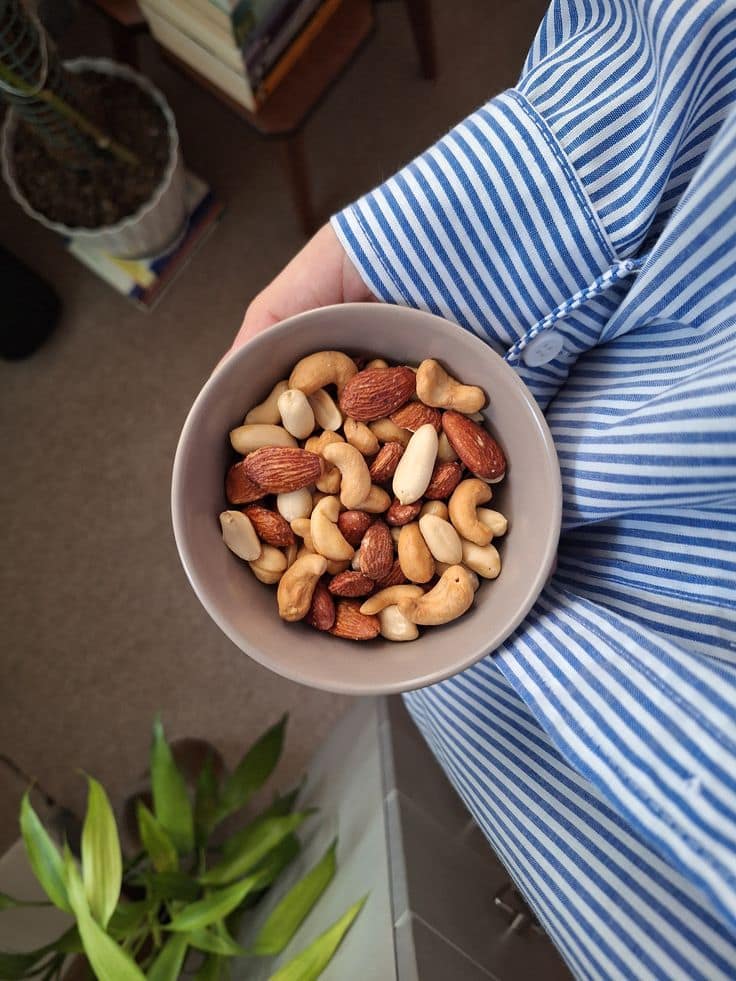
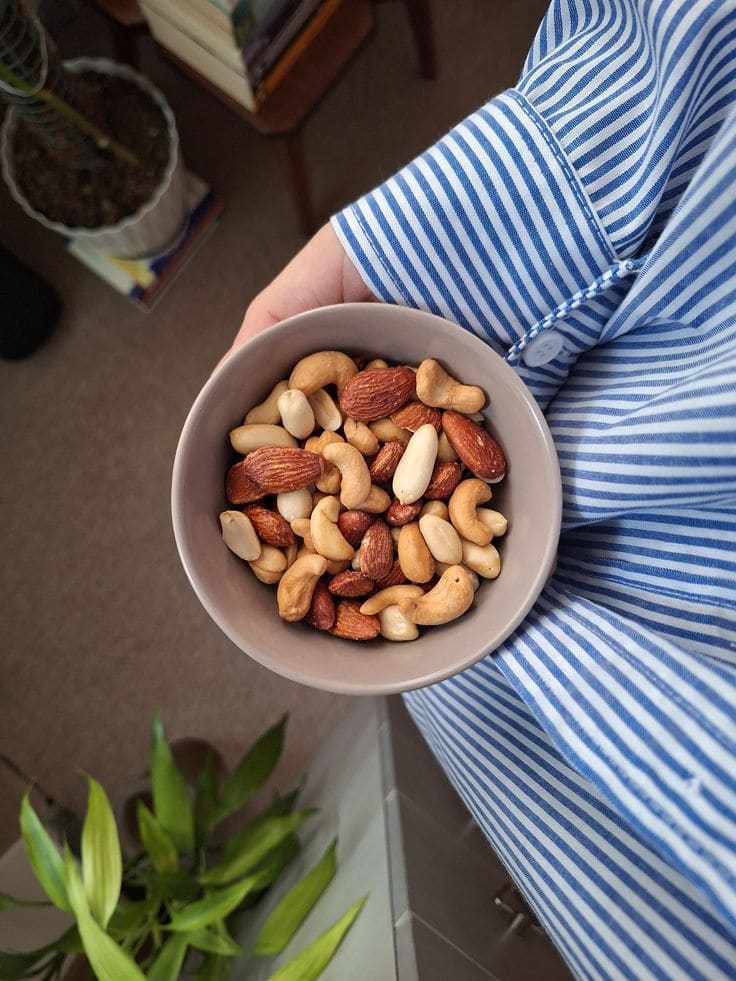
Almonds: 80 mg per oz (about 23 almonds). One of the most practical everyday snacks.
Cashews: 74 mg per oz. Slightly lower than almonds but still a strong source, and lower in phytates than many other nuts.
Sunflower seeds: approximately 37 mg per oz. Lower than pumpkin seeds but still a useful contributor.
Leafy Greens: Magnesium and the Chlorophyll Connection
Dark leafy greens are consistently rich in magnesium because of a remarkable biochemical fact: magnesium is the central atom of the chlorophyll molecule. Every green plant that photosynthesizes needs chlorophyll, and every chlorophyll molecule is built around a single magnesium ion. This means the greener and denser a vegetable is, the more chlorophyll it contains, and therefore the more magnesium.
Cooked spinach provides 78 mg of magnesium per cup. Cooking wilts the leaves and concentrates the nutrient content significantly. One cup of raw spinach contains only about 24 mg because of the air and water that bulk it up before wilting. Swiss chard, kale, and beet greens all follow a similar pattern. When you eat cooked greens, you are eating a nutritionally condensed version of what you see on the plate raw.
Magnesium in Leafy Greens (per cooked cup)
Spinach (cooked)78mg
78 mg / cup
Swiss chard (cooked)75mg
~75 mg / cup
Beet greens (cooked)68mg
~68 mg / cup
Kale (cooked)37mg
~37 mg / cup
Legumes: Beans as an Underrated Magnesium Source
Beans and legumes are often overlooked in magnesium discussions, but they are one of the most affordable and practical ways to meet your daily requirement. Black beans lead the pack at 60 mg per half-cup of cooked beans. Edamame (young soybeans) delivers 50 mg per half-cup. Lentils, kidney beans, and chickpeas all contribute 35-50 mg per serving as well.
Black beans (cooked): 60 mg per half-cup. Add to rice bowls, tacos, or salads.
Edamame (cooked): 50 mg per half-cup. A practical high-protein snack with meaningful magnesium.
Lentils (cooked): ~36 mg per half-cup. Slower to spike blood sugar than most starches and easy to batch-cook.
Chickpeas (cooked): ~35 mg per half-cup. Versatile in curries, roasted snacks, or hummus.
Kidney beans (cooked): ~35 mg per half-cup. Great in soups and chili.
Legumes also come with a bioavailability caveat. Like seeds and nuts, they contain phytates that can bind magnesium in the digestive tract. Canned beans are typically pre-cooked and soaked during processing, which helps. If you cook dried beans yourself, soaking them overnight before cooking and discarding the soaking water will reduce phytate content and improve mineral absorption.
A Note on Absorption: Phytates and How to Work Around Them
Eating a food that contains 100 mg of magnesium does not guarantee your body absorbs all 100 mg. Bioavailability, the fraction that actually enters your bloodstream, varies based on the food's composition. The main factor reducing magnesium absorption in plant foods is phytic acid (phytate), a compound seeds and legumes use to store phosphorus. In the human gut, phytates bind to minerals including magnesium, calcium, iron, and zinc, forming insoluble complexes that pass through unabsorbed.
The good news is that several preparation techniques reliably reduce phytate content. Soaking grains, seeds, or legumes in water activates the enzyme phytase, which breaks down phytic acid. Sprouting (germination) is even more effective. Fermentation, as in sourdough bread, also degrades phytates significantly. Traditional food cultures developed these techniques long before the science was understood, and they remain practical today.
Practical Steps to Improve Magnesium Absorption From Food
Soak nuts, seeds, or legumes in water for 8-12 hours before eating or cooking
Sprout seeds and lentils by rinsing daily for 2-3 days until small tails appear
Choose sourdough bread over regular bread when eating grains regularly
Pair magnesium-rich foods with vitamin D-rich foods (fatty fish, eggs) since vitamin D supports magnesium uptake
Avoid taking magnesium-rich foods at the same time as very high-calcium foods or calcium supplements, which compete for absorption
Cook spinach and other greens rather than eating them exclusively raw to reduce oxalate load
Limit alcohol, as it increases urinary magnesium excretion
Other Notable Sources: Fish, Fruit, and Whole Grains
Dark chocolate (70-85% cacao) provides 50 mg per ounce, making it one of the more enjoyable ways to add magnesium to your diet. The higher the cacao percentage, the more magnesium, since cocoa solids are the source. Milk chocolate and white chocolate have minimal amounts.
Salmon delivers 53 mg per 3-ounce serving of cooked fish, and unlike plant sources, it has zero phytates, so bioavailability is straightforward. Fatty fish in general are reliable magnesium sources alongside their omega-3 content.
Brown rice contributes 42 mg per cooked cup, compared to roughly 19 mg per cup of white rice. Most of the magnesium in rice is stored in the bran and germ layers, which are removed during the milling process that produces white rice. The same principle applies to whole wheat flour versus white flour.
Avocado is unusual among fruits for its mineral density, with a whole medium avocado providing 58 mg of magnesium. Banana adds 32 mg per medium fruit, and while that is not dramatic on its own, bananas are eaten frequently and contribute meaningfully to cumulative daily intake.
Can You Meet Your Magnesium RDA Through Food Alone?
For most healthy adults eating a varied, minimally processed diet, the answer is yes. The male RDA of 420 mg/day and the female RDA of 310 mg/day are achievable through food, but it requires some intentionality. The problem is that about 48% of Americans fall short, primarily because of diets heavy in refined grains, processed foods, and sugar, all of which displace magnesium-rich whole foods.
Certain groups find it harder to meet the RDA through food alone. People with type 2 diabetes often excrete more magnesium through the kidneys. Those taking proton pump inhibitors (PPIs) for acid reflux or diuretics for blood pressure can develop clinically significant depletion. Older adults absorb less magnesium from the gut. For these populations, dietary optimization is the right starting point, but supplementation is sometimes medically indicated.
If you are wondering whether you might be falling short, the symptoms are often subtle at first. Read our guide on signs of magnesium deficiency and our broader article on magnesium deficiency for a clinical picture of what low magnesium looks like over time.
A Sample Day of Magnesium-Rich Eating
The following timeline shows how a practical, realistic day of eating can accumulate enough magnesium from food alone. The amounts are based on the USDA values in the table above. Total for the day: approximately 390-420 mg, meeting or approaching the male RDA and exceeding the female RDA.
Magnesium Through the Day
1
Breakfast~190 mg
Greek yogurt (plain, 6 oz) topped with 1 oz chia seeds and 1 oz pumpkin seeds. Add a sliced banana on the side. Total: 19 + 111 + 156 + 32 = ~318 mg for this meal alone if using full amounts, or reduce portions proportionally. A smaller version with half the seeds gives about 190 mg.
2
Lunch~115 mg
Large spinach salad with half a cup of black beans, half an avocado, and a squeeze of lemon. No exotic ingredients required. Spinach (cooked or raw weight equivalent) 39 mg + black beans 60 mg + avocado half 29 mg = approximately 128 mg.
3
Afternoon Snack~50 mg
One ounce of dark chocolate (70%+ cacao). 50 mg of magnesium and a dose of flavanols. Or swap for a small handful of almonds (80 mg per oz) if you prefer savory.
4
Dinner~95 mg
Salmon fillet (3 oz cooked) with a cup of brown rice and a side of steamed broccoli. Salmon: 53 mg. Brown rice: 42 mg. Broccoli adds a modest ~20 mg. Total: approximately 115 mg.
5
Daily Total~390-420 mg
Across four meals and one snack, this day delivers roughly 390-420 mg of dietary magnesium, meeting the male RDA and comfortably exceeding the female RDA. No supplements needed for a healthy adult eating this way consistently.
When Food Is Not Enough: A Practical Framework
If you consistently eat magnesium-rich foods and still experience symptoms like muscle cramps, poor sleep, or persistent fatigue, dietary intake might not be the only factor. Absorption issues (celiac disease, Crohn's, chronic diarrhea), medication interactions, or elevated physiological demand (intense endurance exercise, chronic stress) can all widen the gap between what you eat and what your body retains.
In these cases, a targeted supplement can be a useful tool. Not all magnesium supplements are equal, however. Magnesium oxide, the most common form sold in pharmacies, has an absorption rate of only about 4%. Chelated forms like magnesium glycinate absorb at 80%+, and magnesium citrate absorbs at 30-45%. For a full breakdown of which form to choose, see our guide to magnesium supplement forms. To understand the numbers behind how much to take, read our article on how much magnesium per day.
The upper tolerable intake level for supplemental magnesium is 350 mg/day for adults. This limit does not apply to magnesium from food, since the kidneys efficiently excrete any excess from dietary sources. Taking more than 350 mg from supplements without medical supervision can cause osmotic diarrhea and, in rare cases with very high doses, more serious effects.
Summary by Food Group: Where to Focus
Rather than memorizing every food individually, thinking by category makes it easy to build a magnesium-rich diet intuitively.
Seeds: The highest concentration of any food group. Pumpkin seeds and chia seeds are exceptional. Add to breakfast, yogurt, or salads.
Nuts: Almonds and cashews are practical everyday snacks. Buy in bulk and portion by the ounce to track intake.
Dark leafy greens: Cook them to get the density benefit. Spinach, Swiss chard, and beet greens lead the category.
Legumes: Black beans, edamame, lentils, and chickpeas. Inexpensive, high in fiber and protein, and batch-cook well.
Whole grains: Brown rice and whole wheat products over white. The difference in magnesium content per serving is significant.
Fish: Salmon and other fatty fish add magnesium with no phytate concerns. A twice-weekly serving contributes meaningfully.
Dark chocolate: A legitimate nutritional food in small quantities. Choose 70%+ cacao for the most magnesium.
Fruits: Avocado and banana stand out, but most fruits are minor contributors. Do not rely on fruit alone for magnesium.
If you are building a complete picture of your magnesium health, understanding how much magnesium per day you actually need is the logical next step after knowing which foods provide it. And if you are experiencing symptoms that suggest you might already be running low, the guide to signs of magnesium deficiency covers the clinical picture in detail.
Real stories, coming soon
Real people, real results
We're putting together real stories from people who use ZavoFit's guidance in everyday life. Coming soon.
Questions, answered.
What food is highest in magnesium?
Pumpkin seeds are the single richest common food source of magnesium, providing ==156 mg per ounce== (about 28 g). That covers roughly 37-49% of the adult daily requirement in a single small handful.
How can I get 400 mg of magnesium a day from food?
Combining a variety of magnesium-rich foods across meals makes it achievable. An ounce of pumpkin seeds (156 mg) at breakfast, a cup of cooked spinach (78 mg) at lunch, half a cup of black beans (60 mg) at dinner, and an ounce of dark chocolate (50 mg) as a snack already totals 344 mg, close to the male RDA.
Does cooking destroy magnesium in food?
Magnesium is a mineral and is not destroyed by heat. However, boiling vegetables and discarding the cooking water can leach magnesium out. Steaming or roasting retains significantly more. Soaking and sprouting seeds and legumes actually improves magnesium bioavailability by reducing phytate content.
Are magnesium supplements better than food sources?
Food provides magnesium packaged with fiber, co-factors, and other nutrients that support absorption. Supplements are useful when diet alone is insufficient or when a clinician identifies a deficiency. For most healthy adults, a varied diet can meet the RDA. Learn more in our article on [magnesium deficiency](/en/blog/magnesium-deficiency).
Do nuts and seeds lose magnesium when roasted?
Dry-roasting causes minimal magnesium loss because magnesium is heat-stable. The bigger factor affecting how much you absorb is the phytate content of the raw seed or nut, which soaking or sprouting can reduce.
Is spinach a good source of magnesium?
Yes. Cooked spinach provides ==78 mg per cup==, making it one of the top plant sources. Raw spinach has less per cup because it is mostly air and water before wilting, but the magnesium content per gram is similar.
Can I get enough magnesium from a plant-based diet?
Absolutely. In fact, plant-based diets centered on seeds, legumes, whole grains, and leafy greens tend to deliver more dietary magnesium than omnivorous diets heavy in processed foods. The key is eating enough total food and variety.
Which fruit is highest in magnesium?
Avocado is the standout, providing ==58 mg per whole fruit==. Banana comes in second at 32 mg per medium banana. Most other common fruits are low in magnesium, so fruit alone is not a reliable strategy for meeting the RDA.
Magnesium drives energy production, muscle contraction, nerve signaling, bone formation, and blood sugar regulation. Here is everything your body uses it for, and why nearly half of people do not get enough.
The official magnesium RDA is 400-420 mg per day for men and 310-320 mg for women, yet the average American gets only about 250 mg. Here is exactly how much you need and how to close the gap.